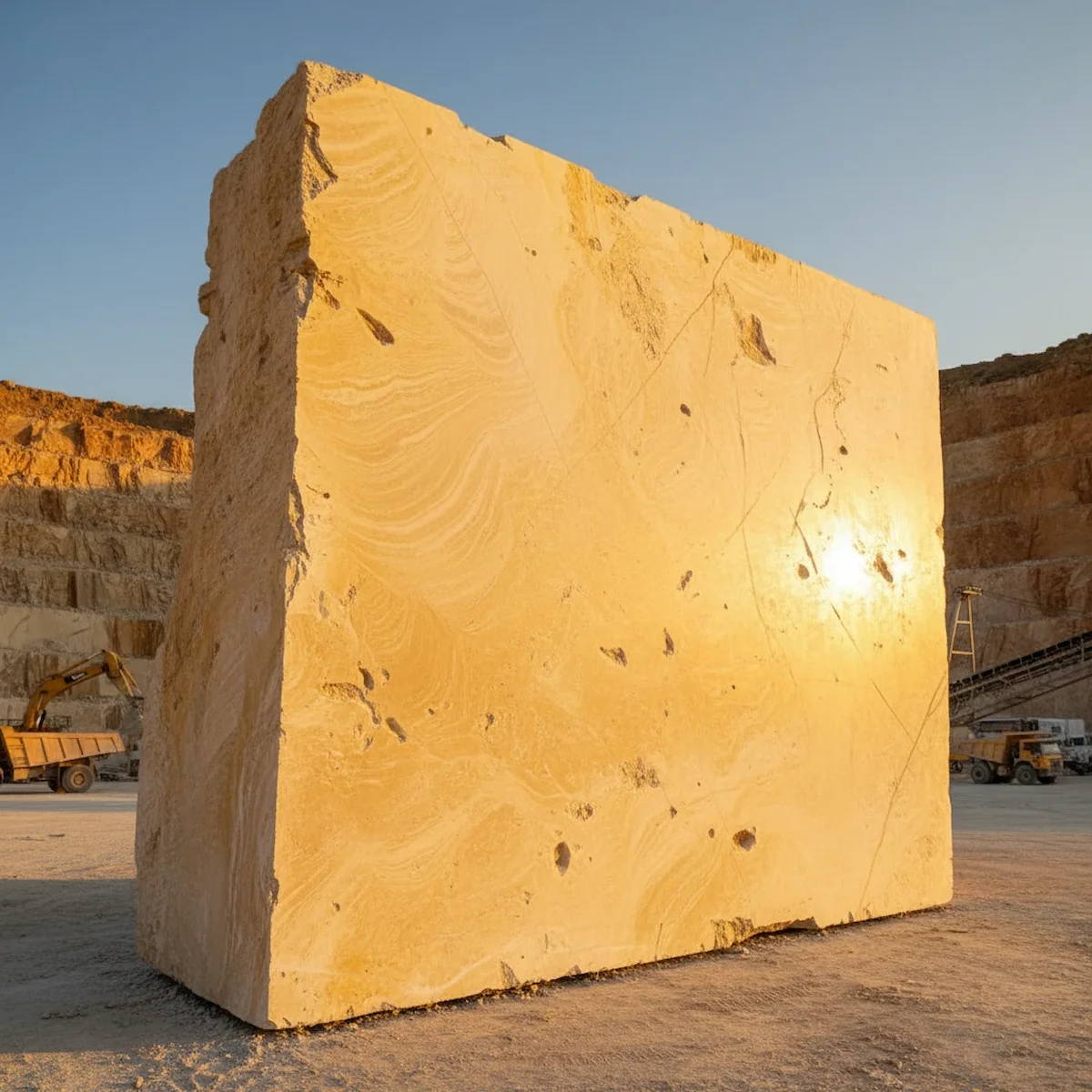
If you walk through the ancient cities of Iran, or gaze up at the modern high-rises of Rome, you will notice a common thread: walls clad in stone that looks like it has been breathing for millions of years. This is travertine.
For centuries, Iranian craftsmen have regarded stone not just as a construction material, but as a piece of history frozen in time. Iran is home to some of the world’s most spectacular travertine quarries, supplying the globe with everything from the snowy whites of Abbasabad to the fiery reds of Azarshahr.
However, there is a question that often whispers in the corridors of architectural firms and construction meetings: “What about the holes?”
To the untrained eye, travertine porosity might look like a weakness. A skeptical client might ask, “Won’t water get in there? Won’t it crumble?” As an exterior designer or stone importer, you need the technical answer to these questions.
The truth is surprising. Those characteristic voids are not defects; they are the secret weapon behind travertine durability. In this guide, we will dive deep into the geology and engineering of porous stones to understand why travertine is often a superior choice for facade stone selection compared to denser, “perfect” stones.
The “Swiss Cheese” Paradox: Why Holes Aren’t Always a Bad Thing
In the world of engineering, we are usually taught that density equals strength. Granite, for example, is incredibly dense and hard. So, why do we see 2,000-year-old structures built of travertine still standing, while some modern granite facades fail after a few decades?
This is the paradox of porous stones.
When we talk about travertine porosity, we aren’t talking about “rot” or decay. We are talking about a natural structural feature. Think of it like the bones of a bird: they are porous to be light, yet strong enough to handle the immense stress of flight.
For a facade project, a stone that is too dense and heavy can actually be a liability. It puts massive dead loads on the building’s frame. Travertine, thanks to its porosity, is lighter than marble or granite of the same volume. This makes it easier to transport, easier to lift, and places less stress on the building’s structural anchors.
The Science of the Void: How Travertine Pores Are Formed
To understand why these holes don’t cause the stone to crumble, we have to look at how they got there.
Travertine is a chemical sedimentary rock. It forms in hot mineral springs—Iran has many of these volcanic-active areas. As the hot water rushes up from underground, it carries dissolved limestone (calcium carbonate). When this water reaches the surface, it releases carbon dioxide gas (bubbles!) and the limestone precipitates, settling in layers.
The “holes” you see are essentially the footprints of ancient gas bubbles and organic matter (like moss or algae) that were trapped as the stone hardened. The stone around these holes is incredibly hard, having been sintered by nature.
So, when you source stone from Eternomarble, you aren’t buying a “soft” stone; you are buying a hard stone with a natural ventilation system.
The Adhesion Advantage: Why Porous Stones Stick Better
Here is a fact that many contractors learn the hard way: Smooth, dense stones are nightmare for wet installation.
If you try to stick a polished, glass-like slab of granite to a wall using mortar, there is very little for the cement to grab onto. It relies entirely on chemical bonding. Over time, with thermal expansion (the building heating up and cooling down), that bond can break, and the stone can detach.
Travertine porosity solves this engineering problem.
When you apply mortar to the back of a travertine tile, the cement paste flows into those surface pores. As it cures and hardens, it creates thousands of tiny “micro-anchors.” The stone effectively locks itself to the wall.
For facade stone selection, this “mechanical interlock” is a massive safety feature. It significantly reduces the risk of delamination (tiles falling off) over decades of service.
Thermal Dynamics: Porosity as a Natural Insulator
Have you ever touched a piece of black granite that has been sitting in the sun? You could fry an egg on it. Now, touch a piece of beige travertine next to it. It will be warm, but rarely scorching.
The air pockets inside the travertine structure act as a natural thermal insulator. Air is a poor conductor of heat. By having these microscopic interruptions in the stone’s body, heat transfer is slowed down.
For exterior designers working in climates with extreme temperature swings—like the deserts of the Middle East or the variable seasons of North America—this is vital.
- Energy Efficiency: A travertine facade helps (in a small way) to insulate the building envelope.
- Structural Stability: Because the stone doesn’t absorb heat as rapidly as dense igneous rocks, it undergoes less “thermal shock.” Rapid expansion and contraction are the enemies of facade longevity; travertine’s porous nature buffers this stress.
The Water & Weathering Challenge: Managing Freeze-Thaw Cycles
Now, let’s address the elephant in the room. Or rather, the water in the hole.
The biggest fear regarding travertine porosity is the freeze-thaw cycle. The logic goes: Water enters the hole -> Water freezes and expands -> Stone cracks.
This is a valid concern, but only if the wrong type of travertine is selected or installed incorrectly.
The Importance of Pore Interconnectivity
Not all holes are created equal. Geologically, we look at whether the pores are interconnected (like a sponge) or isolated (like bubbles in Swiss cheese).
High-quality Iranian travertine generally has a pore structure that allows moisture to escape. The danger arises when water gets trapped. If the stone can “breathe,” the moisture evaporates before it freezes and expands.
Vein-Cut vs. Cross-Cut: How Cutting Direction Affects Water Intake
The way we cut the block at the quarry changes how the pores behave.
- Vein-Cut: Cuts along the layers. This reveals the long, tubular channels of the pores. On a facade, these can act like tiny water pipes if not filled properly.
- Cross-Cut: Cuts across the layers. This reveals the pores as round holes. These are generally more stable for flooring, but both work for facades if the “filling” process is correct.
Iranian Travertine Varieties: Analyzing Density and Pore Structure
At Eternomarble, we deal with the full spectrum of Iranian stones. The geology of Iran is diverse, meaning the travertine durability varies slightly by color and region.

Silver and Titanium Travertine: The Dense Modernists
Silver travertine (often from the Azarshahr, Kashan or Takab regions) typically has a different mineral composition than the beige varieties. It often contains other minerals like iron and graphite. Generally, Silver travertine is slightly denser with smaller, more elongated pores.
- Facade Verdict: Excellent. The modern grey tones hide urban dust well, and the higher density offers great weather resistance.
Beige and White Travertine: The Balanced Classics
Stones like White Travertine (Abbasabad or Atashkooh) are the gold standard. They are prized not just for color, but for a very uniform pore structure. They are “healthy” stones—meaning the material between the holes is solid, not chalky.
-
- Facade Verdict: The most popular choice globally. They reflect sunlight (keeping the building cool) and have a proven track record of centuries.
Red and Lemon Travertine: The Rare Pigments of Azarshahr
Red travertine and Lemon travertine are geological marvels found prominently in the Azarshahr region of Iran. These bold colors are caused by iron oxides and other minerals present during formation.
-
- Note on Porosity: These colored travertines can sometimes have larger, more irregular pores due to the chaotic mineral mixing during their birth.
- Facade Verdict: Stunning for architectural accents. However, because the pores can be larger, high-quality “mastic” or resin filling is essential to ensure a smooth, durable surface that doesn’t trap debris.
Processing for Durability: Filled vs. Unfilled Facades
This is where the manufacturing process makes or breaks the stone.
1. Unfilled Travertine:
Leaving the pores open creates a beautiful, rustic, antique look.
- Pros: No filler to discolor over time; 100% natural look; lighter weight.
- Cons: In wet/freezing climates, water can sit in the holes. Dust and city smog can accumulate in the voids, making the building look dirty over time.
- Recommendation: Best for warm, dry climates or interiors.
2. Filled Travertine (Cement/Mastic/Resin):
For most modern commercial facades, we process the slabs by filling the pores.
- Cement Fill: Durable and cheap, but the finish is matte.
- Resin/Epoxy Fill: Creates a glass-like smooth surface.
- The Eternomarble Standard: For exteriors, we recommend UV-resistant fillers. Cheap epoxy turns yellow in the sun. A high-quality fill seals the travertine porosity from the surface, preventing water ingress while keeping the internal strength of the stone. This gives you the best of both worlds: the look of travertine with the water resistance of marble.
The Architect’s Checklist: Selecting the Right Travertine for Exteriors
If you are an architect or designer specifying Iranian stone, use this checklist to ensure travertine durability:
- Check the “Soundness”: Tap the tile. It should ring, not thud. A thud indicates internal cracks or soft material, not just porosity.
- Inspect the Fill: Run your hand over the surface. The fill should be flush with the stone, not sunken.
- Thickness Matters: For exterior mechanical cladding (dry installation), we usually recommend a thickness of at least 2cm to 3cm to ensure strength around the anchor pin holes.
- Grade Selection: Don’t just look at color. Ask for “Select” or “Super” grades where the pore size is consistent. Avoid low-grade commercial stones for high-rise facades, as they may have large “caverns” weak enough to break under wind load.
Conclusion: Embracing the Imperfection
There is a reason why plastic siding looks cheap and natural stone looks luxurious. Perfection feels artificial. The porosity of travertine—those tiny windows into the earth’s history—gives the stone its character, its warmth, and surprisingly, its engineering advantages.
Travertine porosity is not a defect to be feared; it is a feature to be understood and utilized. It provides thermal insulation, superior adhesion for mortar, and a reduced structural load, all while offering an aesthetic that no man-made material can copy.
Whether you choose the bold Red Travertine of Azarshahr or the serene White of Abbasabad, you are building with a material that has survived millions of years of geology. It can certainly survive your building’s facade.
Are you ready to select a stone that combines ancient beauty with modern engineering resilience?
At Eternomarble, we don’t just sell stone; we curate the best cuts from Iran’s top quarries. Whether you need the density of Silver Travertine or the bold hues of Red Travertine, our experts can guide you to the perfect grade for your specific climate and installation method.
Browse Our Exclusive Travertine Collection and feel free to contact us for more details.
Frequently Asked Questions (FAQ)
Is travertine suitable for facades in very rainy climates (like London or Seattle)?
Yes, but with conditions. The stone should be “filled” to prevent water pooling in the face. More importantly, it should be installed with a drainage plane behind it, or mechanically anchored, so moisture doesn’t get trapped behind the stone.
Does the sun fade the color of Red or Lemon Travertine?
Natural stone does not fade like paint. The colors of Iranian Red and Lemon travertine are integral to the mineral structure (iron oxide). They will remain vibrant for centuries. However, if a cheap filler is used, the filler might yellow or whiten, making the stone look different. Always ask for UV-stable processing.
Which is stronger: Vein-Cut or Cross-Cut?
Generally, Cross-Cut (Fleuri cut) is slightly stronger structurally because you aren’t cutting along the natural separation layers. However, for wall cladding, both are perfectly strong enough if the stone quality is high.
Can I use unfilled travertine outside?
You can, and it looks beautiful (very Roman). However, be prepared to pressure wash it occasionally, as the pores will catch dust. In freezing climates, we highly recommend filled travertine to prevent ice damage.
